Serving all of Chester County, PAOpen 24 hours, 7 days a weekEmergency storm calls: (610) 904-8255
Chester County tree service

Tree Trimming in Chester County: Pruning That Keeps Trees Sound

We prune trees across Chester County for clearance, safety and structure. That means dead wood out, branches lifted off the roof and driveway, and crowns thinned so the tree handles wind better.

Trimming jobs usually start with something specific. A limb is scraping the roof, a branch hangs low over the driveway, deadwood keeps dropping on the deck, or the trees in a West Chester or Downingtown backyard haven't been touched in twenty years and nobody is sure what is safe to leave.

Good pruning is selective. Each cut has a reason, it's made in the right place on the branch, and the tree keeps enough live canopy to stay healthy. We prune to the goal you have for the tree, whether that's clearance, light, a lower storm risk, or a young tree with a better shape.

Tree trimming vs. tree pruning

People use the two words for the same job, and in practice the work overlaps. Pruning usually refers to cutting for the tree's health and structure: removing dead, diseased or poorly attached branches. Trimming usually refers to cutting for clearance and looks. On most visits we do both, and the estimate lists which branches come out and why.

Types of pruning, in plain terms

ANSI A300 is the American standard for tree care, and its pruning terms describe exactly what is being cut. We write them on the estimate.

  • Deadwooding (crown cleaning): removing dead, dying and broken branches, the work that most reduces falling limbs
  • Crown thinning: removing selected live branches to let light and wind through without changing the tree's shape
  • Crown raising: removing lower limbs to clear a roof, driveway, walkway or sightline
  • Crown reduction: shortening the longest limbs back to a lateral branch to reduce height or spread, used where a tree has outgrown its space
  • Structural pruning: shaping young trees early so they grow one strong trunk instead of competing leaders

Why topping a tree backfires

Topping means cutting the main stems back to stubs to make a tree shorter. It looks like a quick fix, but the tree answers with a mass of fast, weakly attached sprouts from just below each cut. Within a few years the tree is about as tall as before, with more branches that are likely to break, and the big stub wounds often decay.

When a tree really is too big for its spot, crown reduction to proper lateral branches is the better option. When reduction can't fix it, removal usually makes more sense than topping.

Clearance over roofs, driveways and wires

Branches resting on a roof wear shingles, fill gutters and give squirrels a ramp. Low limbs over a driveway get torn by trucks. Crown raising and reduction over the house fix most of this without changing how the tree looks from the street.

Wires are different. The utility handles its own lines, so if a branch is touching any wire, including the one that runs from the pole to your house, call PECO or your utility first. Never trim near a line yourself.

Fixing structural problems early

Many of the mature trees in Chester County's older neighborhoods have the same weak spot: codominant stems, two trunks of similar size growing from one union. When bark gets pinched between them, called included bark, the union is weaker, and it's a common place for a big tree to split in a storm.

Pruning can lower that risk by reducing one stem so the other becomes the leader. It works best when the tree is young. On an older tree with a cracked union, pruning may not be enough, and we'll tell you so.

When to prune

For most deciduous trees, the dormant season from late fall through winter is a good time for routine pruning. The leaves are off, so the structure is easy to see, and the ground is often firmer for equipment. Dead, broken and hanging branches can come out any time of year, and storm damage shouldn't wait.

Heavy pruning is best avoided while a tree is pushing out new leaves in spring, when it has used much of its stored energy. Some species have their own timing, and we'll point it out if it applies to your trees.

Where we do tree trimming & pruning

From the West Chester office we cover all of Chester County. Local pages for West Chester and the nearby townships, Exton, Downingtown, Malvern, Paoli & Berwyn, Kennett Square & Unionville, Phoenixville, Coatesville and Chester Springs & Glenmoore explain what tree work looks like in each part of the county, and the full list of Chester County service areas covers the rest.

Related tree services

  • Tree Removal: Safe removal of dead, damaged, leaning and unwanted trees, near houses, wires and fences.
  • Arborist Services: A tree surgeon's eye on your trees: health checks, hazard assessments and a straight answer on treat, prune or remove.
  • 24/7 Emergency Tree Service: Storm-damaged and fallen trees on houses, cars, driveways and fences, day or night.
How it works

How a tree trimming & pruning job runs

  1. Tell us what's bothering you

    Call any time or send photos. A branch on the roof, deadwood over a patio, or a tree you want looked at before winter are all good starting points.

  2. Walk the trees together

    On a free estimate we look at each tree with you, agree on the goal, and write down which pruning types we'll use and roughly how much comes off.

  3. Pruning day

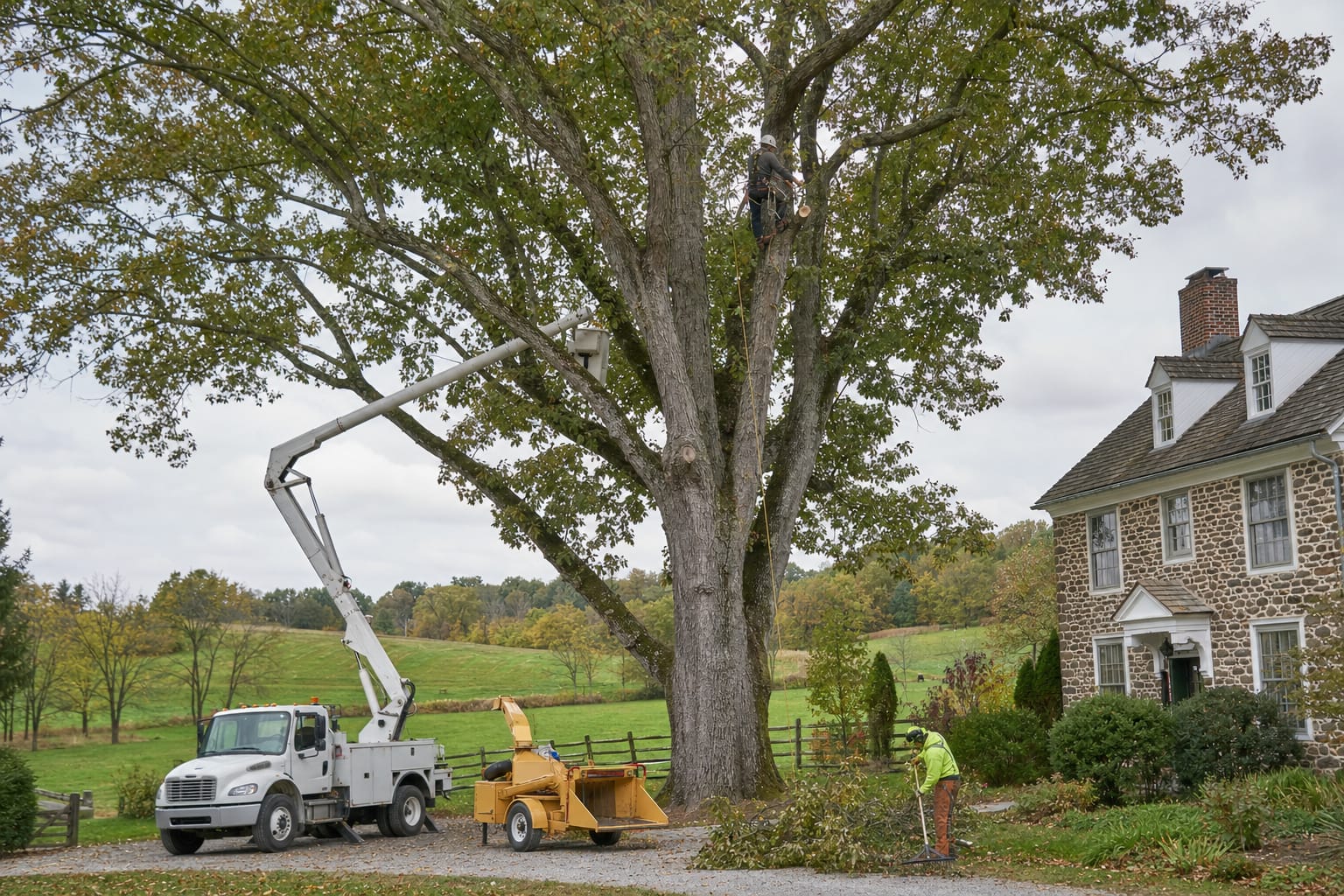
    Crews reach the crown by climbing or with a bucket truck, depending on access. Cuts are made just outside the branch collar, and larger limbs are lowered on ropes over roofs and gardens.

  4. Cleanup

    Branches go through the chipper, wood is hauled off, and the lawn, beds and driveway are raked and blown clean before we leave.

Tree Trimming & Pruning questions

What's the difference between tree trimming and tree pruning?

In everyday use they mean almost the same thing. Pruning usually describes cutting for the tree's health and structure, such as removing dead or poorly attached branches. Trimming usually describes cutting for clearance and appearance, like lifting limbs off a roof. A good job often includes both, and each cut should have a reason you can explain.

What months should you not trim trees?

For most trees, avoid heavy pruning in spring while the new leaves are coming out. The tree has spent much of its stored energy by then, and big cuts set it back. Late fall through winter, when trees are dormant, is a good time for routine pruning. Dead or broken branches can be removed any time, because they're a hazard whatever the season.

Is October a good time to trim trees?

October is fine for removing deadwood and clearing branches off the roof before winter storms. For major structural pruning, many arborists prefer to wait until the leaves have fully dropped and the tree is dormant, usually later in fall or in winter. If a limb is cracked or hanging, don't wait for the calendar.

What happens if you never prune a tree?

Trees in forests do fine without pruning, but yard trees grow next to houses, driveways and wires. Left alone, dead branches build up in the crown, weak unions like codominant stems keep getting heavier, and limbs grow onto the roof. Nothing may happen for years, and then a storm brings down the branch everyone had been ignoring.

How many branches can you cut off a tree without killing it?

There isn't a set number of branches. What matters is how much live canopy comes off at once. A mature tree that loses a large share of its leaves in one visit is badly stressed and can decline. Good pruning removes only what the goal requires, and if a tree needs a lot of work, it's spread over more than one season.

What part of a tree should not be cut?

Don't cut flush against the trunk. The branch collar, the slightly swollen ring where a branch joins the trunk, is where the tree seals off the wound, so the cut goes just outside it. Avoid topping the main stems, and don't cut or bury the root flare at the base of the trunk. Roots near the surface also matter, so think before trenching beside a tree.

Who is responsible for trees around power lines?

The utility handles its own lines. If a branch is touching any wire, including the line that runs from the pole to your house, call PECO or your utility before anyone trims it, and keep people and ladders well away. Never prune near an energized line yourself. Once the line is clear, we can prune the rest of the tree.

Will a tree grow back if you cut all the branches off?

Some species will push out sprouts, but they come back as dense, weakly attached shoots, not the original structure. Many mature trees never recover from losing their whole crown and decline over the next few years. Cutting a tree back to the trunk is effectively a slow removal, so if a tree is truly in the way, a planned removal is usually the better choice.

How to pick a tree trimming company?

Ask how they plan to prune each tree and why. Listen for terms like crown thinning, crown raising and crown reduction, and be wary of anyone who suggests topping. Ask whether they follow ANSI A300 for pruning and ANSI Z133 for safety. Get a written estimate that lists the trees and the work, and check how cleanup is handled.

Free estimates · open 24/7

Tree problem in Chester County? Get it handled.

Call the West Chester office day or night, or send a few details and a photo for a free written estimate. Dan Flynn and the crew cover every township in Chester County.

Tree crew working on a large oak beside a Chester County stone farmhouse
Call 24/7Free Estimate