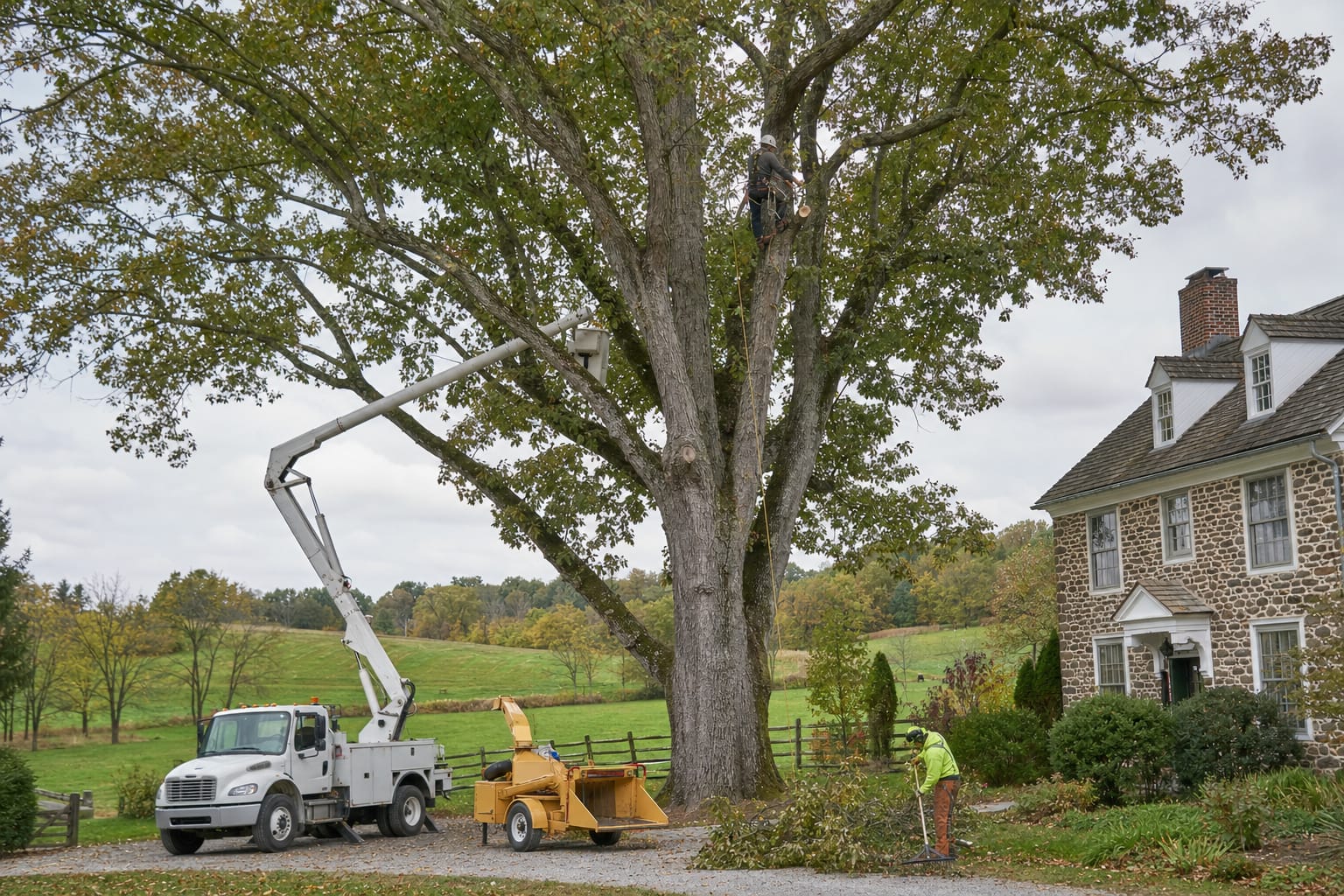
A stump is often what's left after a removal, sometimes ours and sometimes another company's from years ago. It gets in the way of the mower, sends up suckers, and draws carpenter ants and fungi as it rots. In yards carved out of old farmland, there may be several of them hidden in a hedgerow or along the edge of a woodlot.
Grinding is the fastest way to get rid of one. The work is usually quick, the disturbance to the yard is limited, and you decide what happens to the chips.
How stump grinding works
A stump grinder has a heavy spinning wheel fitted with carbide teeth. The operator sweeps it side to side across the stump, taking it down a little at a time until the wood is below the surface. The root flare and the big surface roots radiating from it are ground out too, because they're what trip the mower.
How deep we go depends on your plans. Grass seed needs less depth than a new tree planted in the same spot or a paver patio. Tell us what's going there next and we'll grind for that.
Grinding vs. removing the whole stump
Stump grinding leaves the deeper roots in the ground, where they slowly decay. Full stump removal means digging out the entire root ball, usually with an excavator, which leaves a large hole and tears up much more of the yard.
For lawns, beds and most patios, grinding is enough. Full extraction comes up mainly when a footing, foundation or utility trench has to go exactly where the stump sits. If that's your situation, mention it at the estimate.
Call PA One Call 811 before any digging
In Pennsylvania, call PA One Call at 811 before any digging so the utilities can mark their buried lines. Gas, electric, water and cable lines often run closer to trees than people expect, and a grinder works below the surface.
811 marks lines owned by the utilities. Lines you own yourself, like a feed to a lamp post or garage, irrigation pipe, or an invisible dog fence wire, usually aren't marked. Point them out before we start.
Will the tree grow back after grinding?
Most trees die for good once the trunk is cut and the stump is ground. A few species keep sending up shoots from roots left in the ground. Tree-of-heaven is a well-known example, and Penn State Extension notes that its roots usually need to be treated rather than just cutting the tree.
If shoots appear around an old stump site, cut them as soon as you see them. Each time a shoot is removed, the roots lose more of their stored energy.
What's left after the stump is gone
Grinding turns the stump into a pile of wood chips mixed with soil, usually more material than people expect. You can have the chips raked back into the hole, spread as mulch in your beds, or cleaned up and hauled away.
Chips in the hole decay and settle over the following months, so the spot sinks a little. If you plan to seed grass, it helps to take out most of the chips and fill with topsoil instead.
Gates, slopes and hard-to-reach stumps
Access shapes the job. Stump grinders range from compact machines that fit through a backyard gate to large units that need open ground. When you call, measure the narrowest gate on the way to the stump and let us know about steps, steep slopes, soft ground or a septic field in the path.
Stumps grown against fences, walls, foundations or sidewalks take slower, careful grinding, and the estimate will say if any part can't be reached safely.
Where we do stump grinding
From the West Chester office we cover all of Chester County. Local pages for West Chester and the nearby townships, Exton, Downingtown, Malvern, Paoli & Berwyn, Kennett Square & Unionville, Phoenixville, Coatesville and Chester Springs & Glenmoore explain what tree work looks like in each part of the county, and the full list of Chester County service areas covers the rest.
Related tree services
- Tree Removal: Safe removal of dead, damaged, leaning and unwanted trees, near houses, wires and fences.
- Land & Lot Clearing: Lots, fence lines, overgrown acreage and brush cleared for building, pasture or a usable yard.