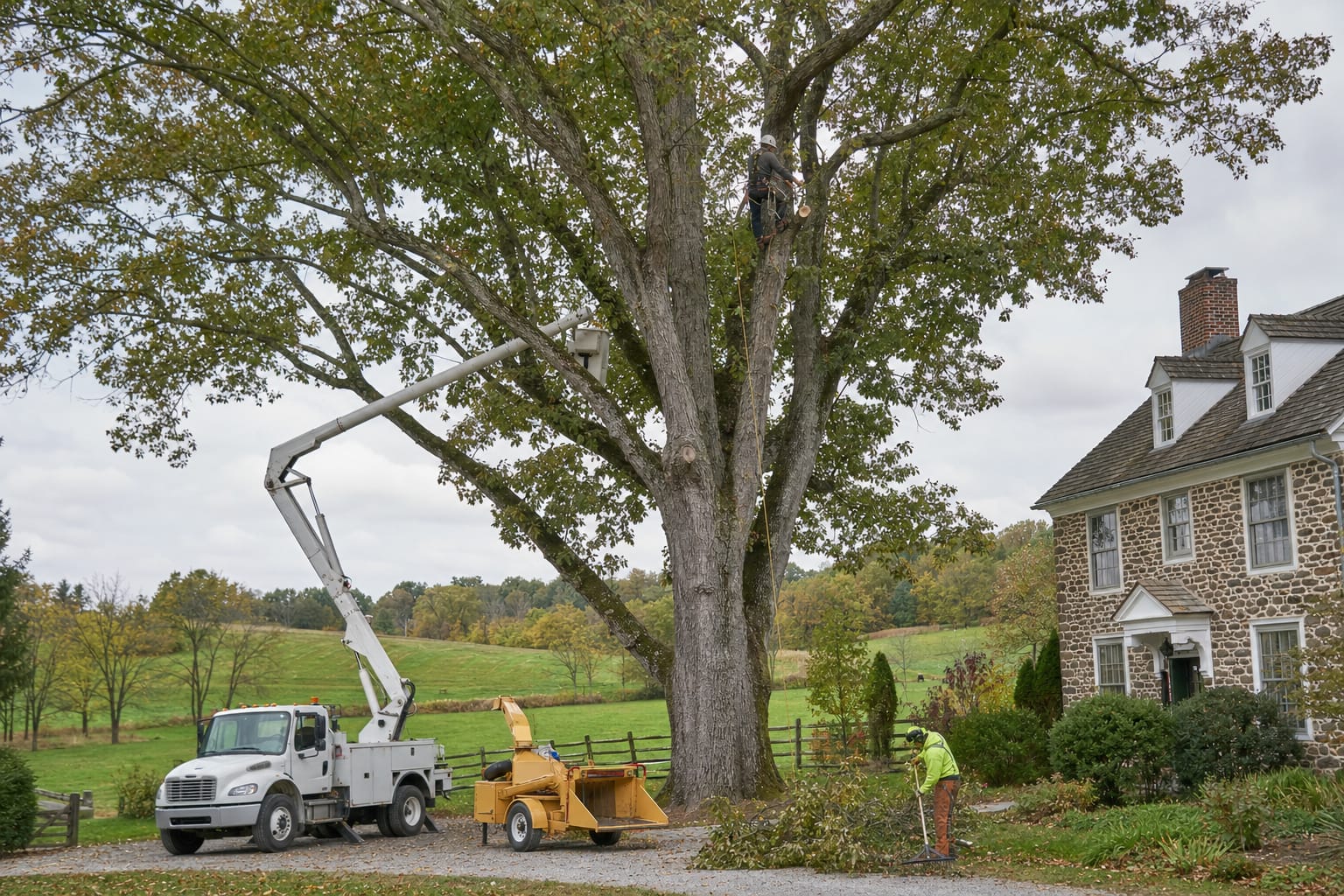
Much of Chester County was farmland, and a lot of it has grown back. Old fields fill in with brush and young trees, hedgerows along former field lines become thick rows of mature trees, and the back half of a property can disappear into vines and thorns within a few years of nobody mowing it.
Clearing jobs come in all sizes. Some owners are getting a lot ready for a new house or addition, some want pasture back, and some just want to use the back of the yard again. The work starts with a site walk to agree on what's coming out and what's staying.
What land clearing covers
Clearing can mean taking a lot down to bare ground for construction, or it can mean selective work that keeps the good trees and removes everything else. Most residential jobs fall somewhere in between.
- Building lots and addition footprints, cleared to the lines on the site plan
- Brush, saplings and vines in overgrown fields and back acreage
- Hedgerows and fence lines where trees have grown up along an old boundary
- Invasive thickets, including tree-of-heaven, that have taken over part of a property
- Access paths, driveways and sight lines through wooded ground
What drives the cost of clearing a lot
We don't publish prices, because clearing jobs vary more than almost any other tree work. These are the factors that set the scope on your estimate.
- How much ground is being cleared, and how dense the trees and brush are on it
- The size of the trees, since large trunks take far more cutting and handling than brush
- What happens to the wood: chipped on site, hauled off, or logs left for you
- Whether stumps are ground, left low, or left for an excavation contractor to pull
- Slope, wet ground, rock, and how equipment gets onto the site
- How close the work is to houses, wires, fences and the trees you're keeping
- Selective clearing, which is slower than clearing everything
Township tree rules and permits
Check the rules before anything is cut. The Chester County Planning Commission found at least 15 Chester County municipalities with tree replacement requirements in their ordinances, and they handle it differently. That means the same clearing job can be routine in one township and need approval in the next.
If the clearing is part of a building project, the approved site plan may already show which trees must be protected and where the limit of clearing is. Bring a copy to the site walk. If there's no plan, call your township or borough before the work, and ask your HOA too if you have one. Clearing that disturbs a lot of soil can also bring erosion control requirements, which your township or engineer can explain.
Keeping the trees worth keeping
On many lots, a few good trees are worth protecting. We flag the keepers with you before work starts and keep machines off their root zones as much as the site allows, because compacted soil and torn roots can kill a tree years after the clearing is done.
Invasive species are usually the first to go. Tree-of-heaven is common on disturbed ground and field edges, and Penn State Extension notes that its roots usually need treatment rather than just cutting. If tree-of-heaven is on your site, plan for root treatment as a separate step.
Hedgerows, fence lines and old farm edges
Hedgerows are some of the hardest ground to clear. The trees grew up along old fence lines, so wire, posts and stones are often buried in the trunks and in the soil at their base. Vines and thorny shrubs fill every gap between them.
Trees with metal grown into them have to be cut carefully, because wire and nails ruin saw chains and grinder teeth and can throw debris. We look for old fencing before cutting, and it's worth telling us if you know where a fence used to run.
Equipment and methods
How a lot gets cleared depends on the site. Trees are felled or taken down in sections with chainsaws, by climbing or from a bucket truck where they stand near buildings. Brush and limbs go through a chipper. Logs and heavy debris are moved with a grapple, a skid steer or an excavator, depending on the ground and the volume. Stumps are taken below grade with a stump grinder when the plan calls for it.
Where we do land & lot clearing
From the West Chester office we cover all of Chester County. Local pages for West Chester and the nearby townships, Exton, Downingtown, Malvern, Paoli & Berwyn, Kennett Square & Unionville, Phoenixville, Coatesville and Chester Springs & Glenmoore explain what tree work looks like in each part of the county, and the full list of Chester County service areas covers the rest.
Related tree services
- Tree Removal: Safe removal of dead, damaged, leaning and unwanted trees, near houses, wires and fences.
- Stump Grinding: Stumps ground below grade so you can mow, plant or regrade, with the chips cleaned up or left for mulch.
- Bamboo Removal: Running bamboo cut, dug and its rhizomes removed, including bamboo spreading in from next door.