A lot of Chester County homes sit under trees that are older than the houses. The boroughs, like West Chester, Phoenixville and Kennett Square, have tall shade trees crowded in beside porches and garages. Out in the townships, many backyards back onto a woodlot or an old hedgerow left over from when the land was farmed. Sooner or later those trees die, split or outgrow their space.
Flynn ChesCo Tree Service works across all of Chester County from our office at 720 East Market Street in West Chester. On every removal we look at three things: the tree itself, what's underneath it, and how we get equipment to it. Then we tell you plainly how it will come down and what the yard will look like when we leave.
Signs a tree needs to come down
Most trees give warning before they fail. These are the signs we look for when someone asks whether a tree should stay or go.
- Dead branches in the upper crown, or a crown that leafs out thinner every year
- Cracks or splits in the trunk, especially where two big stems join
- Codominant stems with included bark, where bark is pinched into the union instead of forming a ridge
- Cavities, soft wood, or mushrooms and conks growing at the base or on the root flare
- A lean that is new, or soil heaving up on the side away from the lean
- An ash tree with a thinning crown, bark flaking off, or woodpeckers working the trunk
Ash trees and emerald ash borer
If you have ash trees on your property, assume they are at risk. Pennsylvania DCNR reports emerald ash borer in nearly every county in the state, and it advises treating only healthy, valued ash trees and removing the rest before they become a hazard. Penn State Extension says removal is the principal control for the insect and that ash trees die after 3 to 4 years of heavy infestation.
Dead ash dries out and gets brittle as it stands. A climber can't trust the limbs the way they could a year earlier, so a dead ash near a house is easier and safer to take down sooner rather than later.
How a big tree comes down near a house
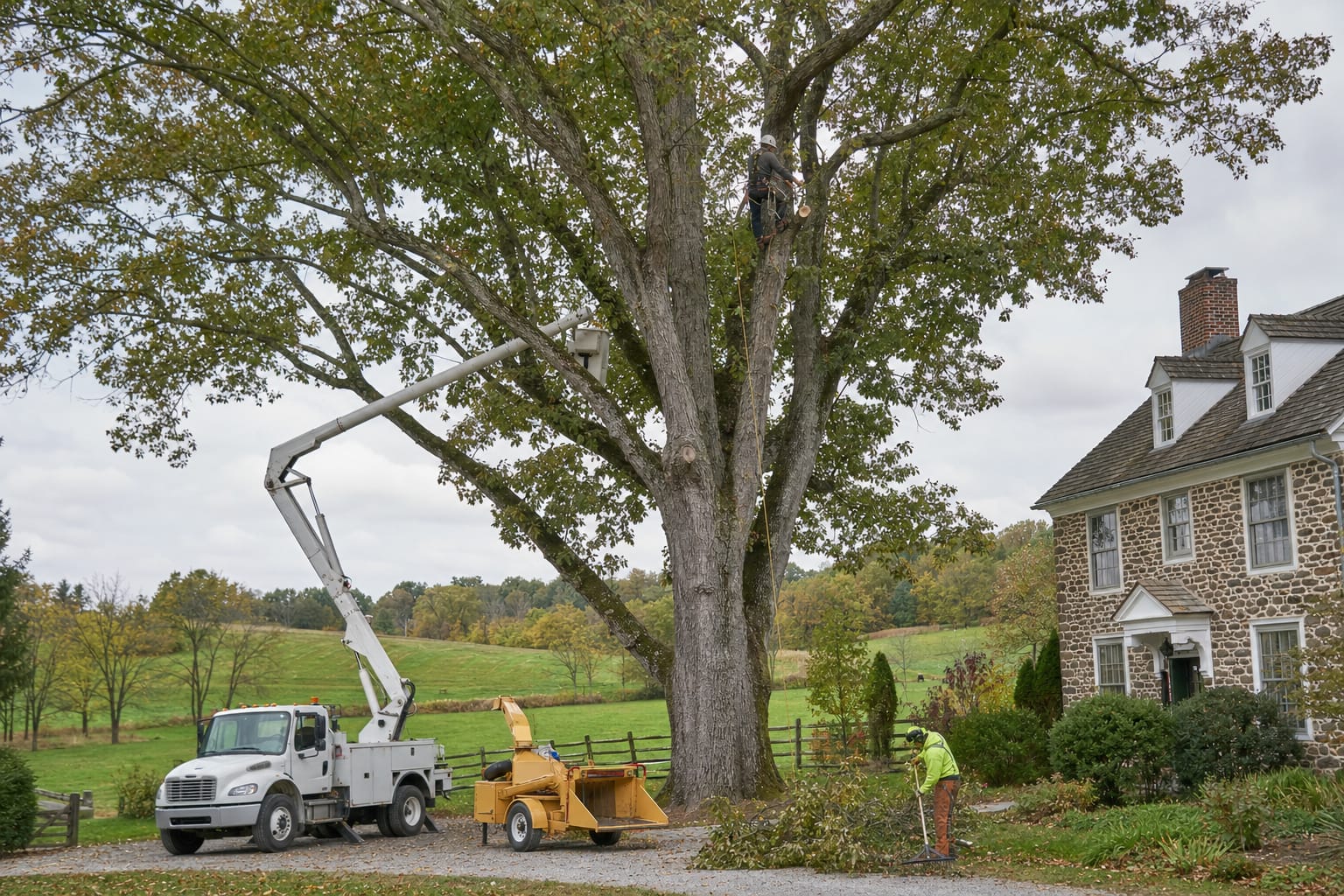
If there's enough open ground, a tree can be felled in one piece into a planned drop zone. In most backyards there isn't room for that, so the tree comes down in sections. A climber or a bucket truck gets up into the crown, and the limbs and trunk pieces are cut and lowered on ropes through a rigging point instead of being dropped. A grapple is often used to move heavy wood across the yard without dragging it over the lawn.
ANSI Z133 is the American safety standard for tree work. It covers the parts of a job that hurt people when they're done carelessly: drop zones, rigging, chainsaw handling and keeping clear of power lines.
Wires, fences and tight access
If any part of the tree is touching a power line, the utility has to deal with the line first. The utility handles its own lines, so call PECO or your utility for anything in contact with a wire, and keep everyone back from it.
Access matters as much as size. Before the job we ask about gate widths, septic tanks and drain fields, soft or wet ground, and anything buried you know about, like a lamp post feed or a dog fence wire.
Selling or buying a home with a problem tree
Home inspectors often write up trees: dead limbs hanging over the roof, a trunk growing against the foundation, branches resting on the service wire, or a big tree leaning toward the house. Once it's in the report, the buyer and seller have to decide who handles it.
A free written estimate gives both sides a real number to work from, whether the seller removes the tree before closing or the buyer takes a credit. If you're the seller, it's easier to schedule the work before the listing goes up than to fit it in during the weeks before settlement.
Township rules before you remove a tree
Rules on cutting trees vary from one municipality to the next in Chester County. The Chester County Planning Commission found at least 15 municipalities with tree replacement requirements in their ordinances, and each one handles it differently. Some boroughs also have a shade tree or tree commission that oversees street trees.
Check with your township or borough before a removal if the tree is between the sidewalk and the street, if the lot is being developed, or if several trees are coming down at once.
Where we do tree removal
From the West Chester office we cover all of Chester County. Local pages for West Chester and the nearby townships, Exton, Downingtown, Malvern, Paoli & Berwyn, Kennett Square & Unionville, Phoenixville, Coatesville and Chester Springs & Glenmoore explain what tree work looks like in each part of the county, and the full list of Chester County service areas covers the rest.
Related tree services
- Stump Grinding: Stumps ground below grade so you can mow, plant or regrade, with the chips cleaned up or left for mulch.
- 24/7 Emergency Tree Service: Storm-damaged and fallen trees on houses, cars, driveways and fences, day or night.
- Arborist Services: A tree surgeon's eye on your trees: health checks, hazard assessments and a straight answer on treat, prune or remove.