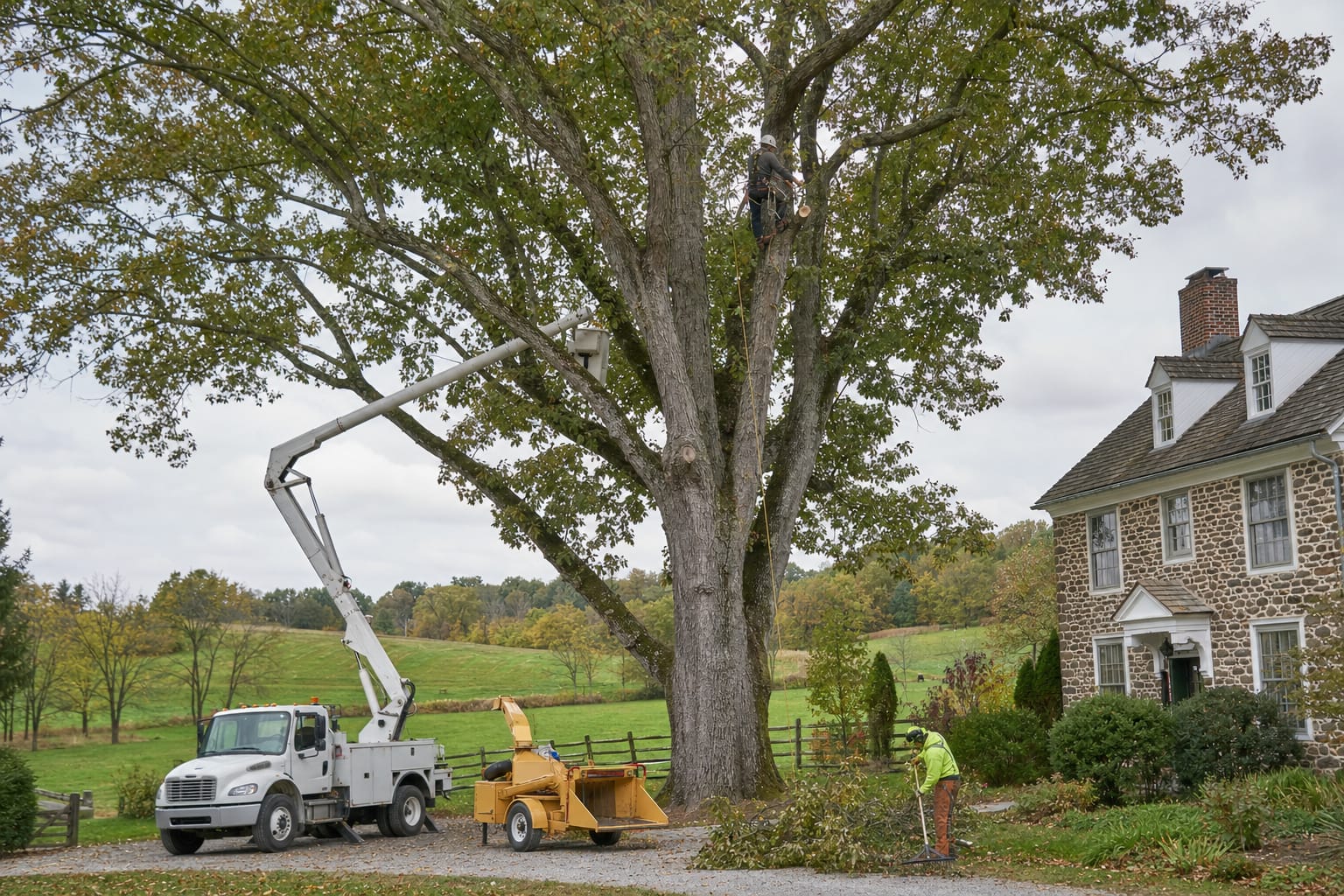
Many of the trees around Chester County homes are big and old. Some were planted along borough streets generations ago, and others were already standing in the hedgerow or woodlot when the house was built. They're worth a lot to the property, and when one starts to look wrong, the hard part is knowing what it means.
An arborist visit is about diagnosis before any cutting. We look at the whole tree from the roots up, explain what we find in plain language, and give you options. Sometimes the answer is to leave the tree alone.
What an arborist looks at
A tree assessment works from the ground up, because many serious problems start at or below the soil line.
- The root flare: whether it's visible or buried under soil or mulch, and whether roots are circling and girdling the trunk
- The trunk: cracks, cavities, seams, oozing, and fungal conks that point to internal decay
- The unions: codominant stems and included bark, where big trees most often split
- The crown: deadwood, dieback at the branch tips, thin or undersized leaves, and early leaf drop
- The site: recent grading, trenching, a new driveway or addition, or soil piled over the roots
Tree surgeon: what the term means
Tree surgeon is the older name for someone who climbs and works on trees: pruning, removing dead and damaged wood, and taking trees down. It's still the standard term in Britain, and many people in the US search for it too. Here, the same work is usually called arborist services or tree care.
If you searched for a tree surgeon in Chester County, this is the service you were looking for. The job is the same: someone who understands how trees grow and fail, and who has the climbing and rigging skills to do the work at height.
Ash, beech and the pests in Chester County
Emerald ash borer has changed what to do about every ash tree. Pennsylvania DCNR reports the insect in nearly every county in the state and advises treating only healthy, valued ash trees and removing the rest before they become a hazard. Penn State Extension says ash trees die after 3 to 4 years of heavy infestation and that large trees should be treated before they're infested.
Beech leaf disease is newer. Penn State reports it in all 67 Pennsylvania counties, and the sign to look for is dark banding between the leaf veins. Spotted lanternfly gets the most attention, but Penn State Extension notes it isn't known to kill plants other than grapevines, tree-of-heaven and black walnut saplings.
Chemical treatment for these problems is a separate job done by a pesticide applicator. Our part is the assessment, and the pruning or removal when that's the right call.
Treat, prune or remove
Most assessments end with one of a few answers. A healthy tree with minor deadwood just needs pruning. A tree with a defect that can be managed, like a long heavy limb over the house, may be fine with crown reduction. A valuable tree facing a pest like emerald ash borer may be worth treating if it's still healthy.
Removal makes sense when the defect can't be managed: a cracked union, decay in the trunk or root flare, or a dead ash next to the house. The size of the risk depends on what's under the tree, so a defect over a bedroom gets a different answer than the same defect at the back of a field.
Trees and construction
Additions, driveways, new patios and utility trenches are a frequent cause of decline in healthy trees. Most of a tree's roots are near the surface and spread well past the branches, so cutting roots on one side or compacting soil with equipment can starve the tree. The damage often shows up as dieback a few years after the project is finished.
If you're planning work near a tree you want to keep, have it looked at before the excavator arrives. It's far easier to change the route of a trench than to save a tree after its roots are cut.
Common mistakes that shorten a tree's life
A lot of tree decline starts with well-meant yard care.
- Topping: cutting main stems back to stubs, which brings weak sprouts and decay
- Mulch volcanoes: mulch piled against the trunk, which keeps the bark wet and invites rot and girdling roots
- Over-thinning: stripping out the inner branches and leaving foliage only at the tips, which puts more load on the limb ends
- Mower and string trimmer wounds at the base of the trunk
- Raising the grade over the roots when a yard or bed is regraded
Where we do arborist services
From the West Chester office we cover all of Chester County. Local pages for West Chester and the nearby townships, Exton, Downingtown, Malvern, Paoli & Berwyn, Kennett Square & Unionville, Phoenixville, Coatesville and Chester Springs & Glenmoore explain what tree work looks like in each part of the county, and the full list of Chester County service areas covers the rest.
Related tree services
- Tree Trimming & Pruning: Pruning for clearance, health and structure: deadwood out, roof and driveway cleared, crowns thinned.
- Tree Removal: Safe removal of dead, damaged, leaning and unwanted trees, near houses, wires and fences.