Summer thunderstorms, nor'easters, wet snow and ice all bring trees down in Chester County. Big shade trees in the boroughs come down onto roofs and porches. In the townships, trees at the edge of woodlots and old hedgerows fall across driveways and back roads. A tree that has been standing for eighty years can come down in a single gust once the ground is soaked.
Emergency calls go to someone who will ask the right questions: is anyone hurt, is anything touching a wire, and is the tree on the house or in the yard. That tells us what has to happen tonight and what can wait for daylight.
Tree down after a storm: the first hour
What you do in the first hour matters more than how fast the tree comes off. Work through these in order.
- Get everyone out of the rooms under or next to where the tree hit, and keep kids and pets away from that side of the house
- Treat every downed wire as live. Stay well back, and call 911 if a line is down, sparking or on fire, or if anyone is hurt
- Call PECO or your utility about any wire the tree is touching, including the line from the pole to the house
- Don't climb onto the roof or start cutting. Branches under load can spring loose when cut, and the tree may still shift
- Take photos and video of the tree and the damage from a safe distance before anything moves
- Call your insurance company to report the damage, then call us so a crew can plan the removal
Trees on houses, cars and driveways
A tree resting on a roof is still a loaded structure. Part of its weight is on the house, part is on the root plate or stump, and branches are often bent under tension. Pulling it off with a truck or cutting the trunk at the base can drop the full weight onto the roof.
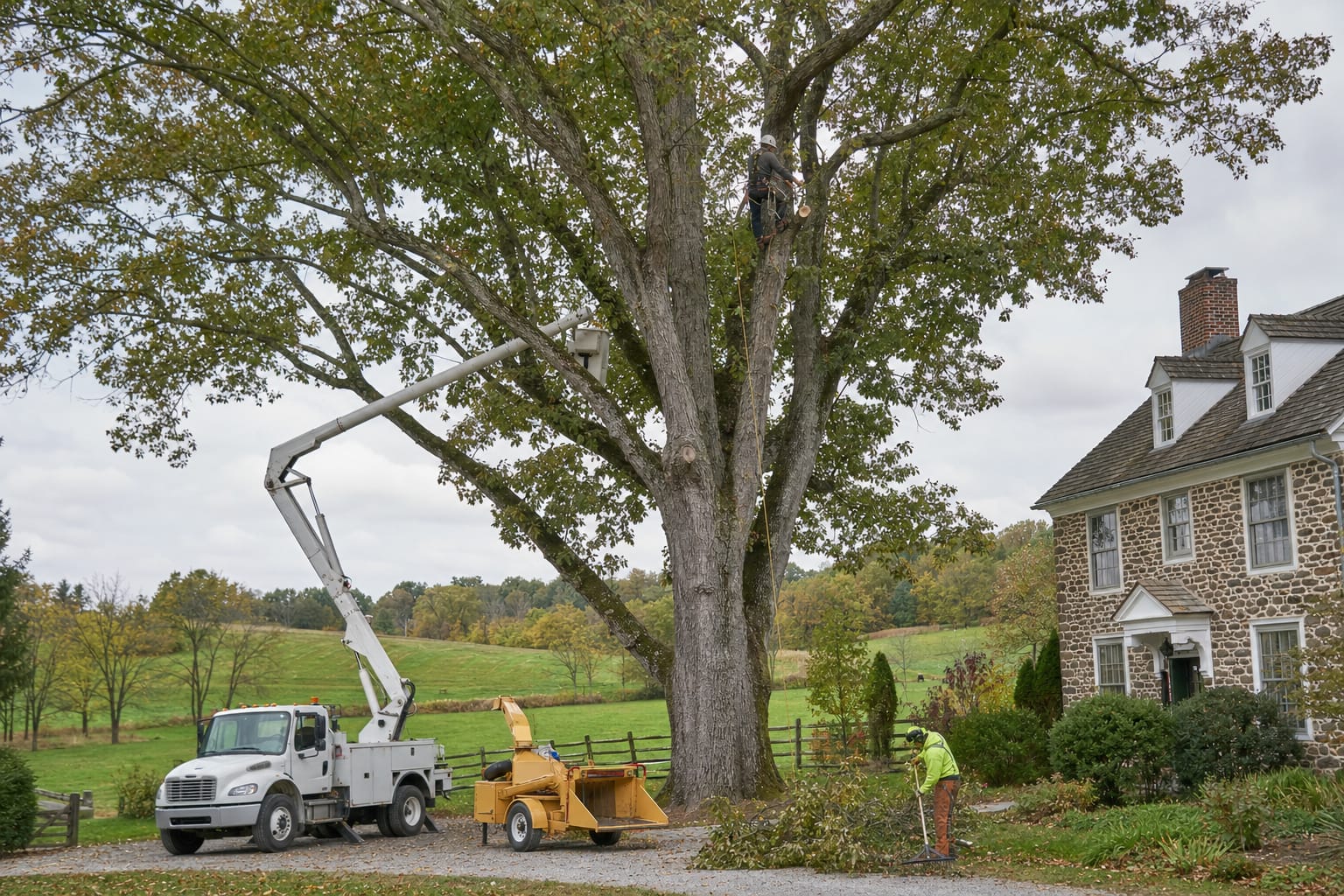
The safe approach is to take the weight off from the top down. A climber or a bucket truck removes the crown in pieces, each lowered on ropes, until what's left can be lifted or rolled off without more damage. Trees across a car or driveway are cut back in the same order, starting with whatever is holding the most tension.
Wires and the line to your house
The utility handles its own lines. If a tree or limb is touching any wire, whether it's the main line along the road or the service drop that runs to your house, the utility has to be called first and the wire made safe before any tree work starts near it.
Once the utility has done its part, we can remove the rest of the tree. Until then, stay back from the wire and anything it's touching, including fences and wet ground.
Hanging limbs, splits and leaning trees
Not every storm problem is a tree on the ground. Some of the most dangerous ones are still up in the air.
- Hanging limbs: broken branches caught in the crown that can drop without warning, often over a walkway or driveway
- Split trunks: trees with two stems that tore apart at the union, leaving half the tree standing and unbalanced
- Fresh leans: a tree that tipped in the storm, with soil or roots lifted on the side away from the lean
- Trees resting on other trees: a fallen tree hung up in a neighbor, which can shift as wind or rain adds load
What can wait until morning
A tree that fell in an open part of the yard and isn't touching anything can usually wait until daylight. So can a limb on the lawn. Those are safer to handle once the storm has passed and the crew can see.
A tree on the house, a tree blocking the only way in or out, or a trunk that's still moving needs a call right away. If you aren't sure which group you're in, call and describe it, and we'll talk it through with you.
After the emergency
Getting the weight off the house is the first visit. Full cleanup, removing the rest of the trunk, and grinding the stump can follow once the urgent part is done and the weather clears.
Storms also show which trees are weak. If one tree failed, look at its neighbors: the same species, the same soil and the same exposure often mean the next storm finds the next weak tree.
Where we do emergency tree service
From the West Chester office we cover all of Chester County. Local pages for West Chester and the nearby townships, Exton, Downingtown, Malvern, Paoli & Berwyn, Kennett Square & Unionville, Phoenixville, Coatesville and Chester Springs & Glenmoore explain what tree work looks like in each part of the county, and the full list of Chester County service areas covers the rest.
Related tree services
- Tree Removal: Safe removal of dead, damaged, leaning and unwanted trees, near houses, wires and fences.
- Tree Trimming & Pruning: Pruning for clearance, health and structure: deadwood out, roof and driveway cleared, crowns thinned.
- Stump Grinding: Stumps ground below grade so you can mow, plant or regrade, with the chips cleaned up or left for mulch.